

The Horizon That Wasn't
Visiting the largest iceberg in the world


The unknown territories of the Arctic and Antarctic have captured the human imagination throughout history, as much as become a scientific measure for encroaching climate change. As the Northern Hemisphere swelters in intense heat, we bring you this month a cooling trio of pieces about perception and the polar lands. First a dispatch from writer Aliaksandr Zherdzeu on visiting the largest iceberg in the world at the time, a giant slab of ice in the South Atlantic ocean that created its own weather, while remaining elusive to the human eye.
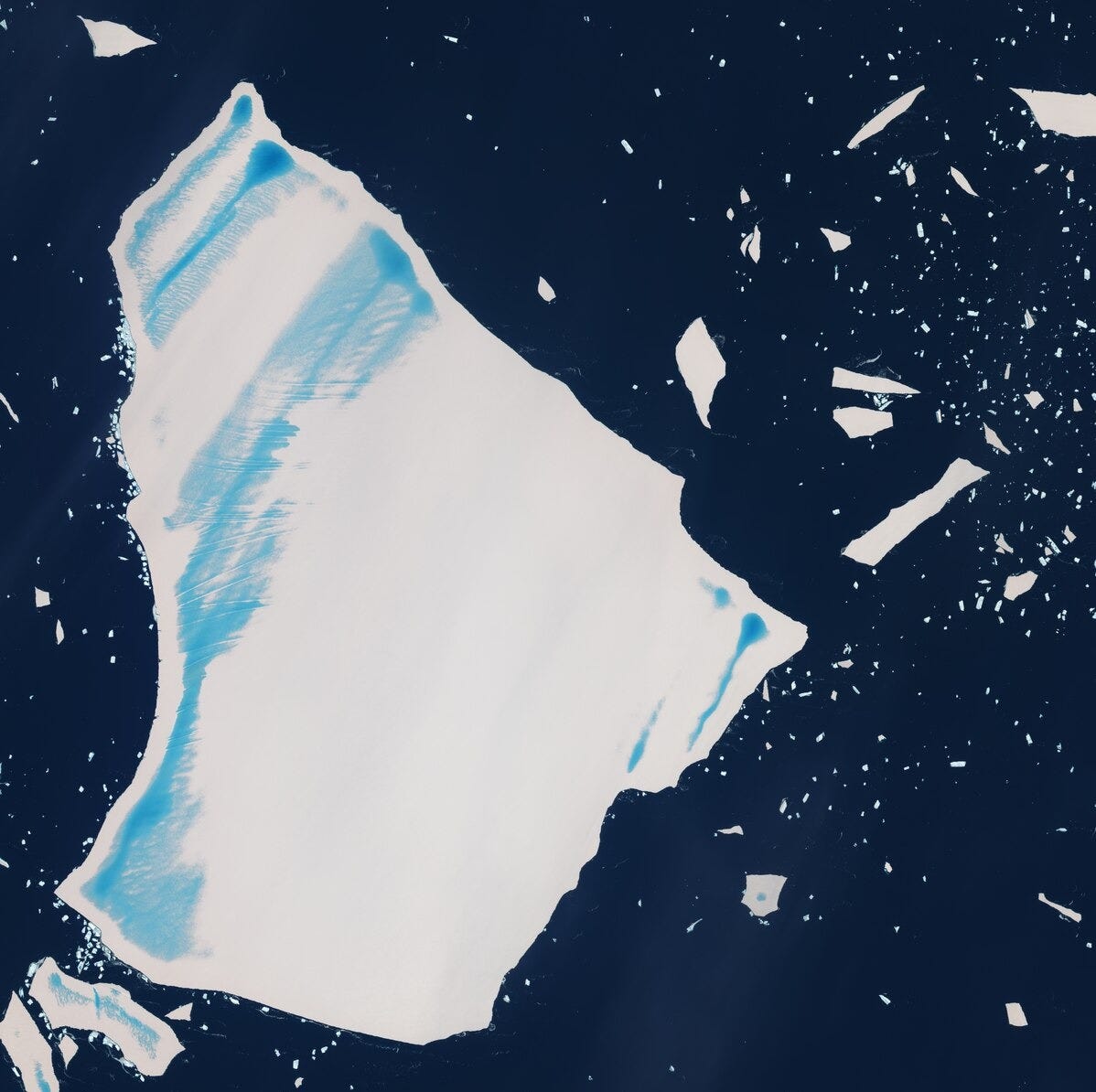
Observation
An announcement came over the intercom from the bridge. The captain’s voice was even as always – no sense of occasion in it. The message was simple: we would soon be approaching iceberg A23a.
I began to dress – not in a hurry, but methodically. Thermal underwear, trousers, a light jacket that wouldn’t catch the wind. Goggles, balaclava, hood. Every layer deliberate. Over time this had become a ritual.
Once, on the crossing to Svalbard, I went out on deck without eye protection. Ocean wind, a few hours, and my eyes were burned so badly they hurt for a long time after. Not from the cold. The wind. Since then, goggles and hood go on automatically. The body remembers its mistakes better than the mind does.
I took my camera and went up to the top deck in front of the bridge – the best vantage point on the whole ship.
There were already a lot of people up there. Among the familiar faces were those who always arrived first: people who were naturally observant, who felt the need to ask questions. The weather was quiet, overcast. A light chop, almost calm. The horizon – a clean line.
I began scanning the horizon for the iceberg, but couldn’t find what I expected.
Everyone around me was looking for the same thing. We expected to see something defined, rising from the water, bluish, a crystalline shape. Like we see in magazines and documentaries – mountains, castles, enormous towers of ice.
But the horizon was empty.
At some point – I can’t say exactly when – I felt colder. Not because of the wind. There was almost no wind. The temperature had simply changed.
It felt the way it does on a hot day when you open a refrigerator and the cold pours out onto you. Not blowing, pouring.
At first I assumed the sensation was due to my clothing: perhaps I hadn’t dressed warmly enough. I turned back to speak to the people I knew nearby.
Only later did I notice that the horizon had changed. It had lost its sharpness. The sky ahead had turned milky, the clouds dissolved into haze, the boundary between sea and sky had begun to blur. But none of us paid any attention to it.
We were looking directly at the iceberg and didn’t recognise it.
We kept looking for the crystal. We were looking directly at the iceberg and didn’t recognise it.
The change came all at once.
Bad weather usually flows over you where you are. This was different: the ship itself was driving into it – bow first, into the wind and the waves, into the world the iceberg had built around itself.
Behind us lay ripples and quiet. Ahead everything was different. The boundary was visible – a dark line across the water.
The waves changed, no longer running in long swells, as they do in the open ocean. They had become short, angular, chaotic. Wind waves, current waves, waves from the ship, waves from falling ice – all of it mixed together.
The ship began lurching sharply in a way I didn’t recognise. After years at sea, I have learned to distinguish between kinds of motion. This was something new.
I have spent fourteen years working on cruise ships. I was drawn to ships and expeditions – to a life spent somewhere between the familiar and the unknown. The dark cabins, the grey metal corridors, and the hum of engines have all become routine. But the sea is endlessly variable.
The sea I love. The ships I have come to know. The industry behind them – that is a different matter. This is the one I chose, partly in order to have experiences I could never otherwise afford. To see what I have not yet seen, not yet felt, not yet lived through.
The wind rose and its cold felt unlike any I had known. The air had grown dense, almost liquid. Everything was mixed into it: ocean moisture, snow dust blown from the surface of the iceberg, fine ice particles, sea spray. It was not fog, not rain, not spray – something in between. It didn’t pierce. It seeped into everything.
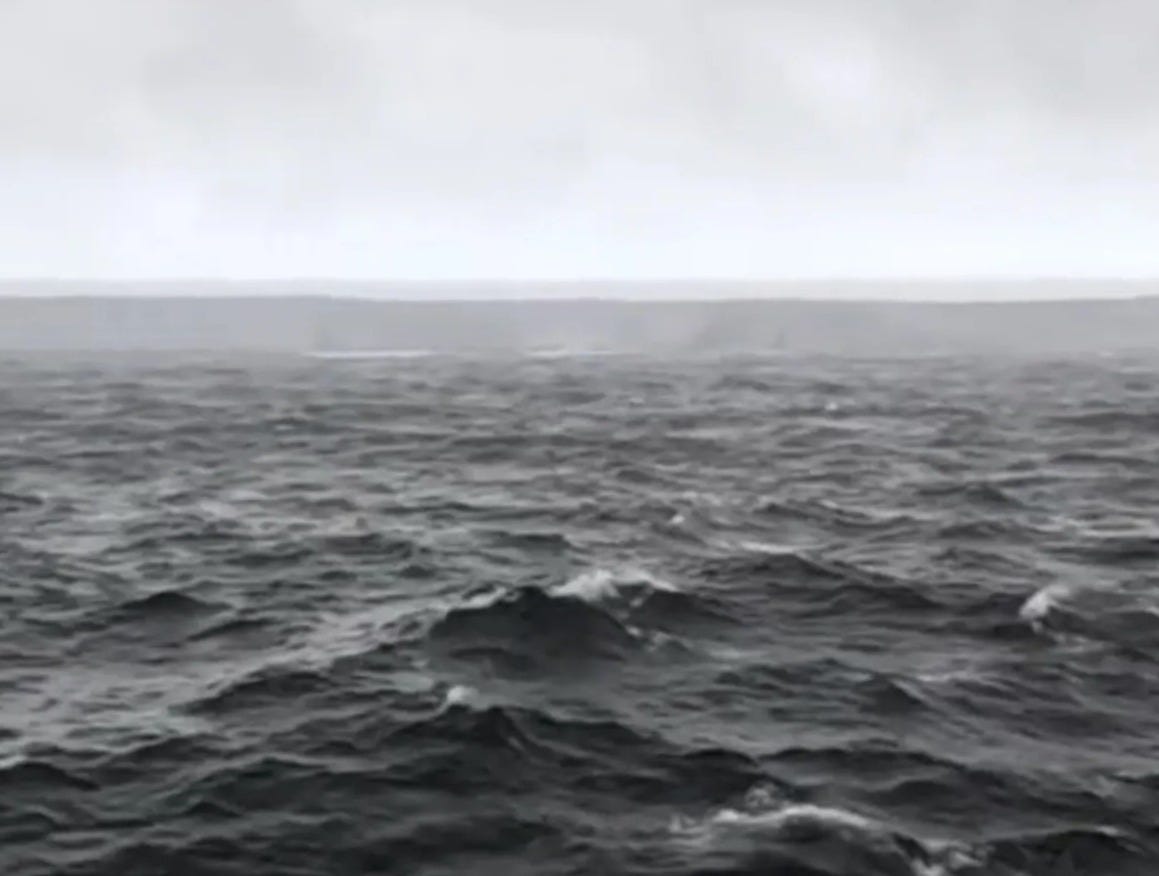
I raised the camera – and lowered it. There was no point in filming. Not because of the moisture. Because there was nothing to see. The iceberg didn’t stand out. Grey lines, white lines, some darker, some lighter. No depth, no colour, no form.
And then someone nearby said out loud: ‘Is that the iceberg?’
Stretching ahead of us was a grey band. It extended left and right as far as the eye could reach. No edge, no form. Slightly darker than the sky, slightly denser than the horizon.
This was the largest iceberg in the world – A23a.
Only then did it become clear what was happening. We had been looking for an object – something separate from the background, a shape against the horizon. But this iceberg was so enormous it had ceased to be a shape. It had become part of the horizon itself.
The wind kept building. Standing on the upper deck became impossible. People began to leave – first one at a time, then in groups. The deck emptied quickly.
I went down to the lower deck where the wind was weaker. For the first time I could properly look at the water alongside the hull. The waves were strange – angular, disordered. They collided and struck the hull in short, heavy blows.
I buried my face in my hood against the wind. In these latitudes it burns the skin the same way frost does.
And then I caught myself doing something unexpected. My back had rounded, my shoulders drawn in, my chin dropped. My body had assumed a protective posture. Without decision, without instruction.
I have spent twenty years paying attention to how I hold myself. In that moment my body chose.
The wind sounded in several registers at once: a low rumble, a middle tone, a high one. They crossed each other, as if several winds were moving simultaneously, each with its own voice. That sound wasn’t only heard – it was felt in the body, like the vibration of bass speakers when you’re standing close to the stage.
Then somewhere off to the side, a piece of ice broke away. Not a crack – a deep, subterranean roar, moving through the space in a heavy wave. I felt where it had come from, and followed it as it spread and faded into the distance.
Small ice fragments began appearing around the ship. We could go no closer, and changed course, swinging around to the direction we had come.
Crossing back over the boundary felt as distinct as the first time. The wind lost its density. The temperature rose quickly – the body felt it before the mind could register it. The waves levelled out and began running in long lines again. The haze cleared. The iceberg became a distant grey band, and then disappeared.
The largest object in the ocean turned out to be the least visible.
We approached it four times, and each time everything happened the same way. The same cold that arrived before the ice came into view. The same wind that didn’t push but poured. The same disordered waves with no direction. The same endless grey band instead of the expected crystal.
Four times – which means it wasn’t an anomaly. The largest object in the ocean turned out to be the least visible. It was almost impossible to see. But impossible not to feel, in everything it did to the space around it.
My memories of A23a don’t come from what I saw, but what I felt.
Reflection
Later, on shore, I began looking for accounts from other people who had approached the A23a iceberg. I wanted to know if they had seen the same thing.
It turned out that personal accounts barely exist. Most of what has been written about the iceberg is data: dimensions, mass, drift speed. Or imagery: satellite photographs, drone footage, pictures taken from ships.
But what a person feels standing next to something like this – that is almost nowhere described.
The first thing I found was not a personal account, but an explanation from NASA glaciologist Kelly Brunt: ‘We get two types of icebergs. We get the type that everyone can envision in their head that sank the Titanic, and they look like prisms or triangles at the surface.’ A jagged peak thrusting up from the sea.
The other type is the tabular iceberg: flat, wide and so enormous that it reads not as an object but as part of the horizon.
Reading this, I understood that what we had experienced was not the exception. We were looking for the shape we knew. And we failed to recognise the one we had never seen before.
We were looking for the shape we knew. And we failed to recognise the one we had never seen before.
Later I came across notes from Richard Sidey, who filmed A23a using a drone on a separate expedition. He wrote that the iceberg is too large to photograph as a whole – it extends in both directions as far as the eye can see. But there was another observation in his account. When the drone flew low, below the level of the ice plateau, the air was almost calm. But as soon as it climbed higher – a powerful wind immediately pushed it back.
I remembered how I had moved down from the upper deck without explaining to myself why. The body simply chose where it was easier to stand. The drone’s instruments recorded what my body had felt before I had time to understand it.
And finally, the words of the expedition leader, Ian Strachan: ‘Icebergs of this scale create their own weather.’
Not just cold and wind. A separate microclimate. A separate world with its own rules.
A world that no longer exists. Having moved into warmer waters, A23a began to disintegrate in early 2025. Our expedition was able to approach it before it disappeared at last.
I entered that world four times – and left it four times. Each time the boundary was equally sharp. I never truly saw the iceberg itself. But the world it created around itself – that was impossible not to feel.
Aliaksandr Zherdzeu was born in the wetlands of Belarus’s Polesia – landlocked, far from any sea. He has spent most of his life on one since. For years he kept field notes: weather, creatures, the presence and absence of people. Less than a year ago, these became stories. The polar regions, Oceania, parts of Africa – these shaped him most.
Our Latest Issue
Dark Mountain: Issue 29 (£19.99)
Our Spring 2026 anthology is a hardback collection that steps outside the human bubble and puts animals at its heart. Order from our website or take out a subscription to future issues of Dark Mountain and get Issue 29 for only £14.99.
The Dark Mountain Project is an entirely reader-funded organisation. If you enjoy these newsletters or posts, please consider supporting our work by visiting our shop or becoming a subscriber to our books and/or our online weekly edition on Substack. All back issues in the archive are available both in print (Issues 21, 22, 25-28) and PDFs (from £5). Many thanks!
 | A guest post by
|
Great observations and they create a gripping story