

Thaw
The lie of 'raising awareness'

‘Climate collapse … does not announce itself in a single image or a single statistic. It unfolds slowly’. For decades now, artists and writers have visited the vanishing ice floes of the Arctic to bring back a record of our planetary crisis. But how effective is their creative work?
This month, the artist Richard Koscher joins The Arctic Circle residency aboard the Rembrandt van Rijn for a 16-day expedition through Svalbard. His project, Ghosts of the Ice, combines thermochromic paintings that vanish with heat, a documentary, and a serialised blog on themes of loss, climate, and disappearance. Second post in our series on the polar lands and the human imagination. With existential artwork by Will Gill from Issue 11.
THERE IS A PHRASE I HAVE HEARD SO OFTEN that it has begun to lose all shape. It floats through artist statements, panel discussions, grant applications, captions beneath burning forests and melting ice. It sounds responsible. It sounds generous. It sounds like action. The phrase is ‘raising awareness’.
I used it myself for years without thinking much about it. That is part of the problem. The phrase does not invite thought. It invites agreement. Once spoken, it closes the conversation instead of opening it.
How many times have you seen an image, nodded quietly, felt a small tightening in your chest, and kept scrolling. The ice is melting. Awareness raised. The forest is burning. Awareness raised. A painting is stolen. Awareness raised. The planet is warming. Awareness raised. What happens next is rarely mentioned. The phrase implies that something has been accomplished. Recognition becomes a conclusion rather than a beginning.
Awareness has quietly become a moral finish line.
The danger is not that people do not care. The danger is that caring has been compressed into a moment so brief it requires nothing of us beyond acknowledgment. Once we know, we are done. We have fulfilled our obligation. We are free to move on.
Climate collapse does not work this way. It does not announce itself in a single image or a single statistic. It unfolds slowly, unevenly, across decades and regions and lives that never trend. Ice does not vanish in one dramatic instant. It thins. It cracks. It recedes. It disappears while no one is looking. A system built for reaction is incapable of holding this kind of loss.
This is why awareness feels productive while changing nothing.
We live in a culture where millions can watch a climate documentary, feel briefly moved, and return to lives structured in exactly the same way as before. Emissions continue to rise. Systems remain intact. Attention moves on. The illusion of progress is comforting. It allows us to feel engaged without being implicated.
Artists are often asked to contribute to this illusion. ‘Raise awareness’ usually means make something legible. Make it clear. Make it consumable. Make people feel informed, perhaps even virtuous, for having encountered it. The request is rarely to disturb or unsettle or demand time. It is to package concern in a way that does not linger.
This is where I began to feel resistance.
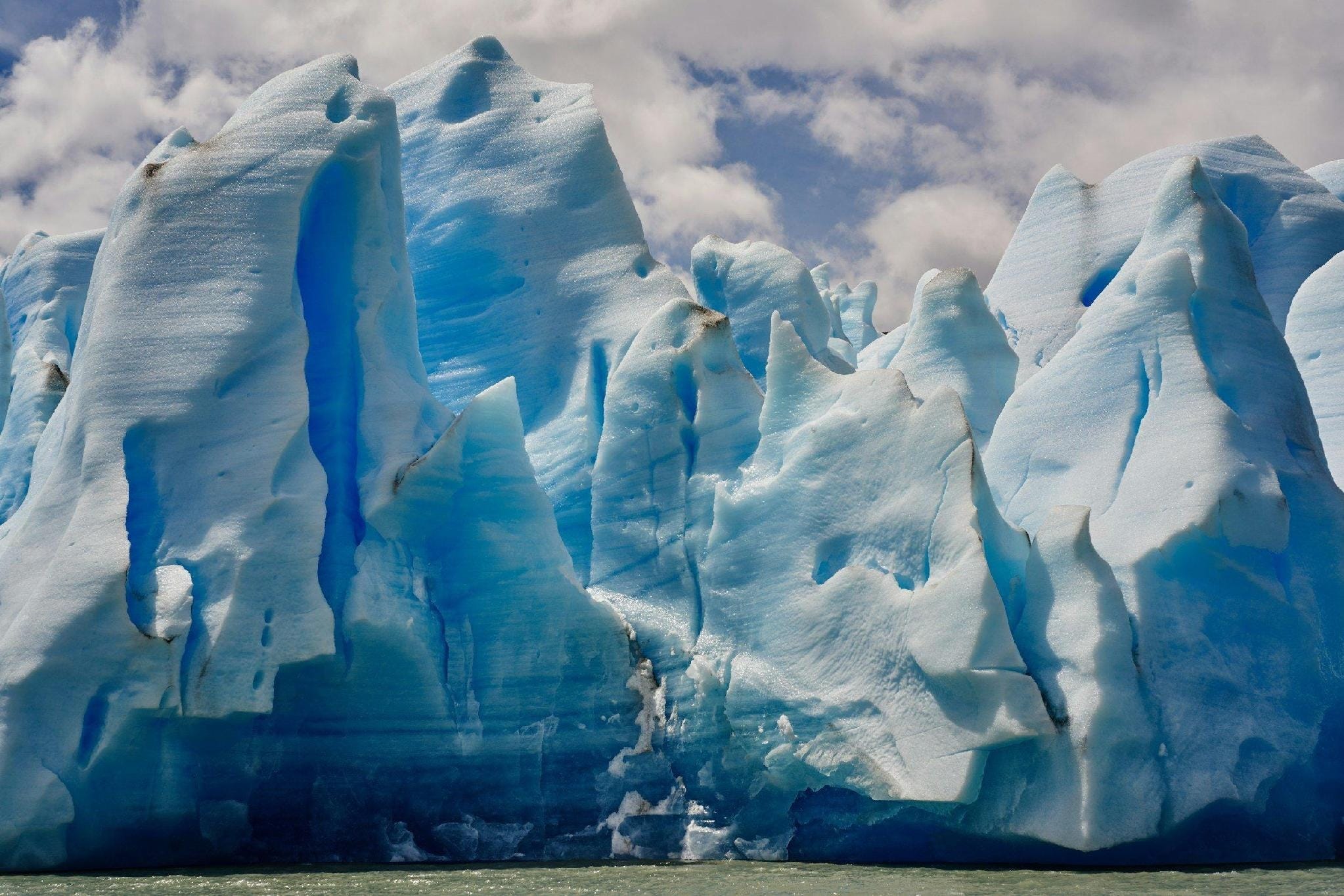
Art has never changed the world by explaining it. Its power lies elsewhere. It slows time. It interrupts habit. It creates spaces where resolution is withheld. The works that stay with us do not inform us. They trouble us. They refuse to let us move on easily.
Marina Abramović asking people to sit, to wait, to remain exposed to time. James Turrell shaping light so slowly that perception itself becomes the subject. These artists did not raise awareness. They altered states. They made looking difficult. They asked something of the body, not just the intellect.
This is closer to what I am trying to do.
Ghosts of the Ice is not a project about information. No one needs to be told that ice is melting. We already know. Knowing has not saved it. The project is about witnessing. About staying with disappearance long enough that it cannot be dismissed or resolved into a headline. About letting loss unfold in front of you without explanation or solution.
The thermochromic paintings are central to this. They do not illustrate climate data. They enact it. The image does not disappear because you understand why. It disappears because the temperature crosses a threshold. Slowly. Quietly. Without drama. You stand there and watch a painting fade, not as a metaphor but as an event. There is nothing to do. No button to undo it. No caption to reassure you. You wait. You feel the absence arrive.
This is not awareness. It is exposure.
I am often asked what the goal is. The question itself reveals how deeply we rely on awareness as an endpoint. Goals imply solutions. Metrics. Outcomes. This project has none of those. Its ambition is smaller and more difficult. To make you sit in a room with something vanishing and notice what happens inside you when nothing arrives to rescue the moment.
Leni Riefenstahl understood something uncomfortable about this. Her films for the Nazi regime, the Nuremberg rally in Triumph of the Will and the Berlin Olympics in Olympia, are morally indefensible, but their technical mastery is undeniable. She did not aim to inform. She aimed to overwhelm. To move bodies before minds. To make images that bypassed reason entirely. That power is dangerous. It can be abused. It can also be understood. Feeling precedes thinking. Without feeling, thought rarely changes behaviour.
Discomfort is not a failure of art. It is often the beginning of responsibility.
We live in a culture that treats discomfort as something to be resolved immediately. Scroll past. Click away. Replace the feeling with another stimulus. Awareness fits perfectly into this loop. It creates a brief disturbance and then disappears. The system remains intact. Nothing demands that we stay.
We live in a culture that treats discomfort as something to be resolved immediately.
I am not interested in contributing to that economy.
If this work succeeds, you will not leave feeling informed. You will not leave inspired. You will not leave with a sense of completion. You will leave unsettled. Perhaps even annoyed. Something will remain unresolved. That residue matters more to me than agreement.
The Arctic does not ask to be understood. It does not care if we are aware of it. It continues to change regardless of our recognition. The only honest response is to witness that change without rushing to explain it away.
Awareness lets us move on. Witnessing does not.
That difference is everything.
Richard Koscher is an Austrian-born artist and writer based in San Anselmo, California. This July he joins The Arctic Circle residency aboard the Rembrandt van Rijn for a 16-day expedition through Svalbard. His project, Ghosts of the Ice. reimagines three famous lost masterpieces, a Klimt burned in 1945, a Rembrandt stolen in 1990, a Matisse stolen in 2012, as oil paintings with thermochromic pigments, mounted in heated frames the viewer controls. Turn the dial up, the painting fades. Each work carries two dates: the year it was made, the year it was lost. The repainting becomes a measurement of how much ice has vanished between those moments. The premise is simple. Scientific data alone has not moved people to act. Art can carry what data cannot, the bridge from awareness to empathy and empathy to responsibility. The Arctic is the first of two chapters.
Other recent entries from the Ghosts of the Ice series:
— Entry Sixteen: Why Social Media Can’t Hold Scale
— Entry Twenty-Six: What We Lose Along the Way
Richard is also the author of REVEAL: The Power of Appropriation Art (2024) rmkartist.com
MAIN IMAGE:
Will Gill
No Man’s Land #1
Pigmented ink on Hahnemühle Photo Rag Ultrasmooth paper
Svalbard, Norway
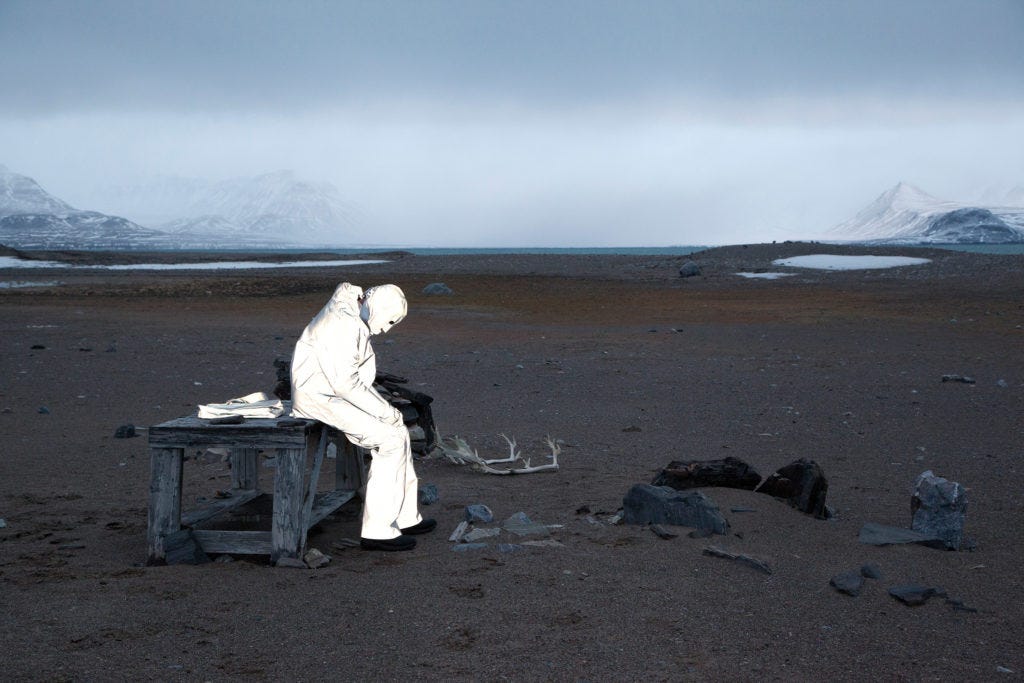
Part explorer. Part outcast. Part survivor. From the series No Man’s Land by Canadian artist Will Gill, these images were made during an artist residency in Svalbard, Norway, in the autumn of 2014. Twenty-eight artists from around the world sailed aboard a three-masted barquentine to one of the most forbidding environments on the planet. Accompanied by sculptural props and a custom-made light reflective suit, the artist set out to stage photographs in the alien landscape. The results explore aspects of life somewhere near the end: resignation, curiosity, boredom, hope, wonder and despair. (from Dark Mountain: Issue 11)
Our Latest Issue
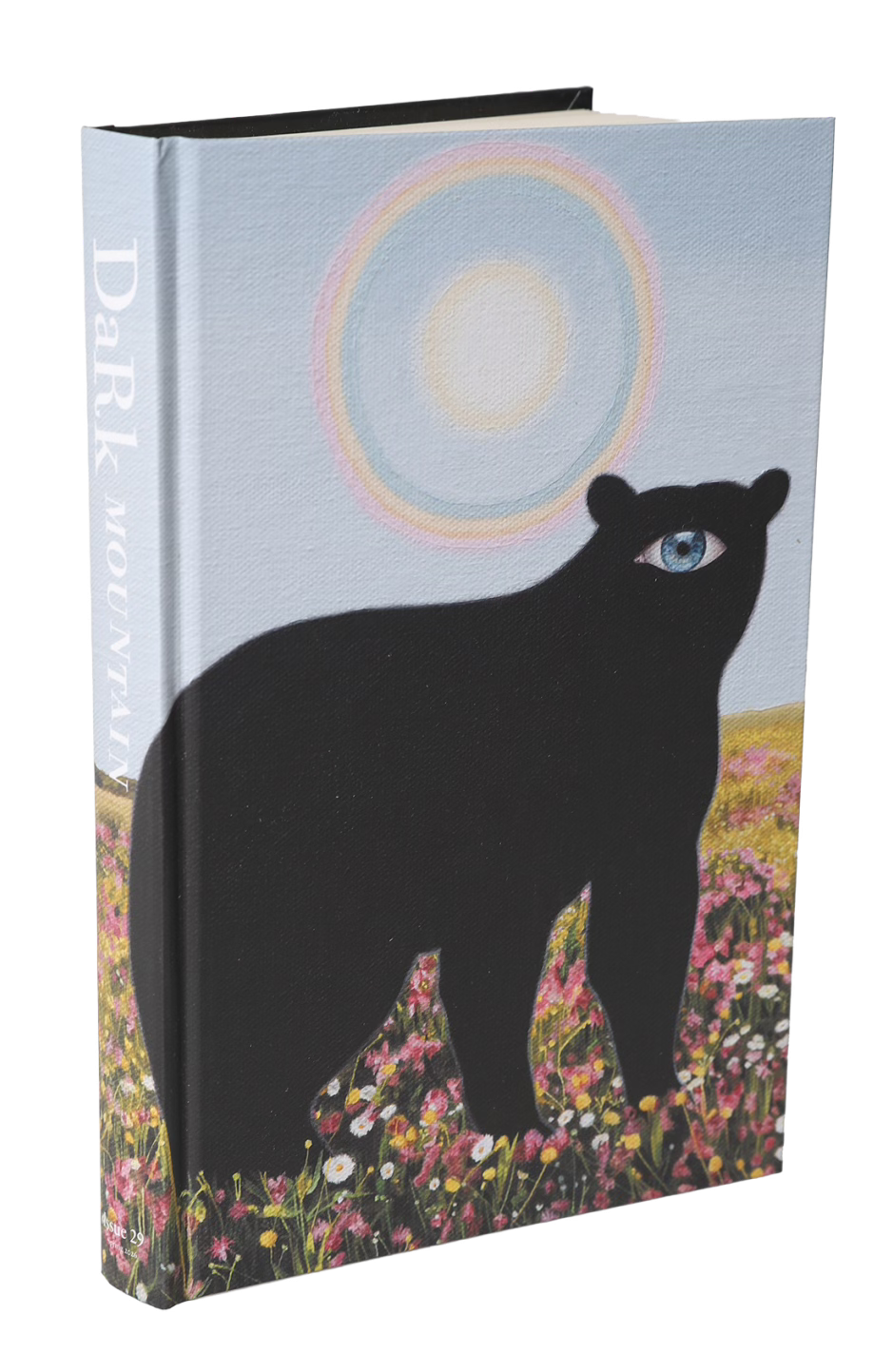
Dark Mountain: Issue 29 (£19.99)
Our Spring 2026 anthology is a hardback collection that steps outside the human bubble and puts animals at its heart. Order from our website or take out a subscription to future issues of Dark Mountain and get Issue 29 for only £14.99.
The Dark Mountain Project is an entirely reader-funded organisation. If you enjoy these newsletters or posts, please consider supporting our work by visiting our shop or becoming a subscriber to our books and/or our online weekly edition on Substack. All back issues in the archive are available both in print (Issues 21, 22, 25-28) and PDFs (from £5). Many thanks!
This is utterly brilliant. Thank you so much. "It allows us to feel engaged without being implicated."- that's exactly it.
Beautiful project!