

On Colossal Wrecks
A film journey into the concrete heart of COP28


‘I also want it to be true that the things that art is good at – inhabiting feelings in bodies, noticing how at a critical juncture in history no-one has all the answers – might belong to our resistance too.’ Armed with a selfie-stick and troubling questions, filmmaker Josh Appinangesi walks into the citadel of Dubai as the planetary conference begins.
His documentary, ‘Colossal Wreck’ continues its UK screenings (with Q & A) in Bristol this Saturday (film trailer at the end of the piece).
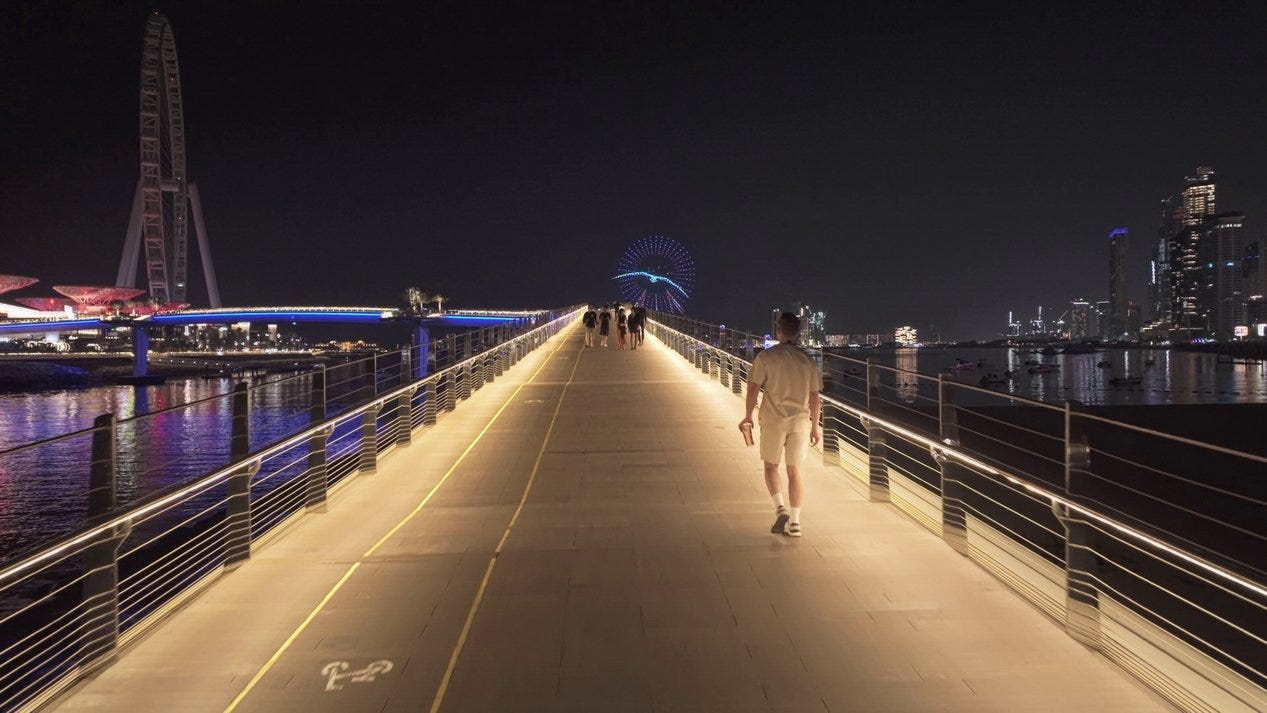
MUCH OF THE WRITING in the Dark Mountain Project brings us to places where wild nature abides – even if abraded or catatonic, as if awaiting our demise in order to flourish again. My path as a filmmaker led me instead to another kind of Dark Mountain: Dubai, a towering citadel-colony of glass and steel, a place that greets you with an obdurate wall of heat, ozone and concrete haze, entirely denuded of bird- or insect-song.
Insofar as anywhere on our planet is not natural, Dubai would be that place. And nor is it a place I’d choose to spend my time, although millions of tourists make the choice every year. On this particular occasion, 70,000 delegates, of which I was one, had shown up to a city-sized conference centre to hawk their wares, represent their interests, and venture to forge an agreement, or at least the posture of one, in the global circus we call COP (Conference of the Parties).
It all worried me, but as a filmmaker I knew I needed to shelve, as far as I could, my assumptions, and remain open to the seductions of Dubai, if for no other reason than to end up with,, not just another exhausted ecological warning or political plea, but something akin to art.
I arrived, however, with plenty of assumptions. I was there because I’d been asked to screen my previous feature documentary, MY EXTINCTION, at COP28. While making that film, I’d hung out in activist circles, particularly Extinction Rebellion (XR). I’d been a participant-observer in several protests, including the Tufton Street protest in London in 2020 organised by Writers Rebel, which shed light on that street’s cabal of so-called think tanks. So I entered COP conceiving of it very much in the terms of my fellow protestors at such events – as the emblematic get-together of a deeply problematic globalising agenda that had little to do with real change, and probably hindered it.
So these were some of the questions that accompanied me on my journey: Can the most powerful people in the world really save the planet through a ‘conference of parties’? Or is their meeting just the performative politics of greenwashing? Could anything matter less than the toothless agreements that emerge from these fiascos, leaving us in ruins after three decades of abject failure? On the other hand, what if these conferences had never taken place at all – might things then be even worse? And what about those who live daily on the cutting edge of climate injustice? Are their voices integrated meaningfully into the COP panoply, or are they there to be tokenised - part of a manufacture of consent that pays lip service to dispossession and indigeneity while baking in the old post-colonial tenets of indebtedness and control?
Yet, while those questions bore down on me as I slunk around the conference armed with a barely noticed camera-stick, they weren’t really what guided me. Which has made speaking about my project rather tricky. After all, these are the sort of questions you might reasonably expect journalists to ask when you release a film like the one I decided to surreptitiously shoot on my travels. A ‘proper’ documentarian might well be expected to tackle such questions head on. I don’t really think of myself that way, though. Something about such huge themes and quandaries makes me shy. Something about the process of making and constructing a classical campaigning documentary – getting access to capture the lives of those suffering injustice and those wreaking it, crafting a narrative that exposes us to this pain, then likely provides some vague uplift at the end to give courage and a ‘call to action’ – renders me exhausted and incapable. I’m no good at it.
I did find myself, though, haunted by other questions. Like – it’s an old one – what the hell do you do, faced with this madness? What is the right human response in a moment like ours, when global leaders and tech overlords are exerting not only extractive and colonial but overtly fascist tendencies? It’s not that protest, campaigning and organised resistance aren’t critical places to funnel your despair, rage and guilt towards; they are, of course. But I also want it to be true that the things that art is good at – eschewing discourses of knowledge, power and position-taking, inhabiting feelings in bodies, noticing how at a critical juncture in history no-one has all the answers – might belong to our resistance too. Uncertainty, ambivalence, listening.


So if the film I made has to do with political thought, it’s more about holding a mirror to the fragments of language I heard bandied around at COP, as well as flying around inside the echo chamber of my own algorithm-addled head. Someone said to me recently that AI can’t do ambiguity, it can only do data points. Yes: because, to not know exactly what you think or feel, to not know exactly what is right or wrong when it comes to survival, requires you to have feelings, and for those, you need to have a body that is vulnerable, suffering and mortal.
To not know exactly what is right or wrong when it comes to survival, requires you to have feelings, and for those, you need to have a body that is vulnerable, suffering and mortal.
Maybe, then, it made a kind of sense, when entering somewhere so computationally figured out in advance – so much so that it feels like a video game or an architect’s walkthrough – to attest primarily to my own human alienation. I wandered the ‘streets’, such as they are, accompanied by the only other humans who weren’t driving, mostly low-paid, quasi-indentured Gastarbeiter of Asian origin, and tried to figure out how the hell we had come to this and why the hell we were all here.
And what I thought would be funny – I use funny as a guide rail quite a bit, as the emergence of some remnant moral dissonance I still vaguely trust – what I thought would be funny would be to narrate my journey not directly, but through an AI-generated clone of my actual voice. The robot ‘me’ yields a tone that is flattened, uncanny, with flashes of inappropriate emotion. It felt appropriate when narrating a place that was less generative than generated. In fact it struck me, somewhat paradoxically, as the tech utopia/dystopia’s ‘indigenous’ voice. For like AI itself, Dubai is a black box that appears to have emerged painlessly, noiselessly, weightlessly. You move through Dubai as if walking on air via its clean, slickly effective pathways, which were in fact made on the backs of those very real gastarbeiter I’d spotted by night working behind the scenes.
Dubai seduces you quickly with its convenience and sci-fi futurism, so much so that you forget how it came to be here at all – through the massive expenditure of cheap labour, oil wealth, highly leveraged financial instruments and the thousands of planners, architects, data centres and global franchises brought in to design and deliver it. Its massive failure of the imagination – with its simulated everything, including simulated beachfronts with sand shipped in – echoes our own failure of the imagination to apprehend how we’ve remade our world in our own image.
But then, if we are to apprehend our reality, we need first to acknowledge the very real pleasures and excitements it offers so many of us. In Dubai, for instance: the biggest building in the world! The biggest shopping mall in the world! The biggest indoor ski resort in the world! All in a 50 degree climate! Bewildering achievements at every turn.
Luckily I had the help of composer Vik Sharma – tracks partly borrowed from his recent climate album Listen Without Listening, and partly scored for Colossal Wreck. It’s a soaring, elegiac synth-driven brain-melt, the soundtrack of the dreamlike techno-utopianism of this fantasy cityscape that accompanies us as we glide through its enticements and ironies, our way eased by the 24-7 aircon that renders the city liveable by humans. It further accompanies us as we witness the wonder of the world’s biggest aquarium, enabled by the massive desalination plants that have rendered the effluent coastline unliveable to the self-same animals that giant fishbowl puts on show. It’s irony and heartbreak at the same time: you need both at once, if you want to avoid collapsing into cynicism or sentimentalism.
Towards the end of my trip of four short days meandering friendlessly about the roundtables and showrooms and panel talks and exclusive hotel cocktail parties full of green tech CEOs hosted by a major tech COO, I started to wonder if anything could pierce this alienation.


Then, something did. At a poorly-attended ‘Evening of Indigenous Celebration’ on one of many stages, this one hosted by Extreme Hangout, the well-intentioned NGO that had also invited my film, I got to hear the indigenous leader of the Guarani-Kaiowa people, Brazilian anthropologist and campaigner Valdelice Veron. She spoke in Brazilian Portuguese about the plight of her people at the frontline of climate injustice – murdered, tortured, raped and assaulted by landowners and police alike in land clearances that had been taking place for years, but were also taking place at that very moment. It was impossible not to cry. This was a voice of urgency utterly unlike that of the business-as-usual language the rest of us were all caught in, finance bros and activists alike.
This was a voice of urgency utterly unlike that of the business-as-usual language the rest of us were all caught in, finance bros and activists alike.
But – as the film shows rather brutally – mere moments after her speech, when our collective breath came back, we delegates soon found ourselves returned to the same familiar patter. There were things to do, places to be. Were we returned intact after hearing her? Or returned a little differently? If the latter, then I suppose there must be hope.
And there was another voice that also seemed to cut through. Not human, but cetacean. At an art event on the beach on my last night, we were invited by the marine biologist and writer Tom Mustill to a sound bath of recorded whalesong. The mournful grandeur of the whales felt like a plea, one that escaped language, and somehow returned us to it. I’m humanising, perhaps the voice of the whales remained implacable to complete anthropomorphisation. That feeling of adjacent otherness was strangely restorative. The whales were both us and not us.
The hope bit at the end: what I learned later was that the profound sense of alienation I’d felt at COP was shared by pretty much everyone I met there. Deeply concerned and knowledgeable people, far more effective and engaged than myself, and coming from every field – tech, science, international development, activism – were all ambivalent about what they were doing in this place, or whether any good could derive from it. We were all lost. All desperate. All hypocrites. As such, one message I gleaned from our collective efforts was that hypocrites must be made welcome in our movements and connections. COP, I’d understood, was a horrorshow, but it might also be both cancer and cure. And to altogether abandon our international structures and fora, however counterproductive they may be, might be even worse than sticking with them - especially given that, as we’re now seeing, what replaces internationalism is generally an even darker nationalism. But I remain uncertain.
As I came to leave Dubai, I realised I was going to miss, despite everything, its strange history-ending cocktail of gaudy, sci-fi hypercapitalism and Islamic conservatism. It has a frenetic sense of pace that is also a kind of stillness; the way a mirage shimmers in a deathly still desert, energetically hastening its own transformation into a sunbaked carcass of white glass and golden bone. I knew, too, that I was unlikely to return there – unless the truth is I already am there. For isn’t Dubai just the clearest expression and exponent of where we all already live?
And on the pedestal, these words appear:
My name is Ozymandias, King of Kings;
Look on my Works, ye Mighty, and despair!”
Nothing beside remains. Round the decay
Of that colossal Wreck, boundless and bare
The lone and level sands stretch far away1
COLOSSAL WRECK is out in cinemas now and will be online in 2026. All viewing options available here: dartmouthfilms.com/colossalwreck
IG: @colossal.wreck @joshappfilm
Josh Appignanesi is a filmmaker whose work spans fiction, documentary and the space in-between. His seven feature films range from hybrid documentaries like My Extinction, The New Man and Female Human Animal to indie movies like The Infidel and Song of Songs. They have been released theatrically in over 30 territories and online in over a hundred with platforms including BBC and Mubi. His widely acclaimed work gained competition slots at Tribeca, Rotterdam, Cannes/ACID, Berlin and Sheffield festivals, with awards at London, Edinburgh, Turin, as well as Kodak, BIFA and BAFTA nominations. joshappignanesi.com
Our Latest Issue
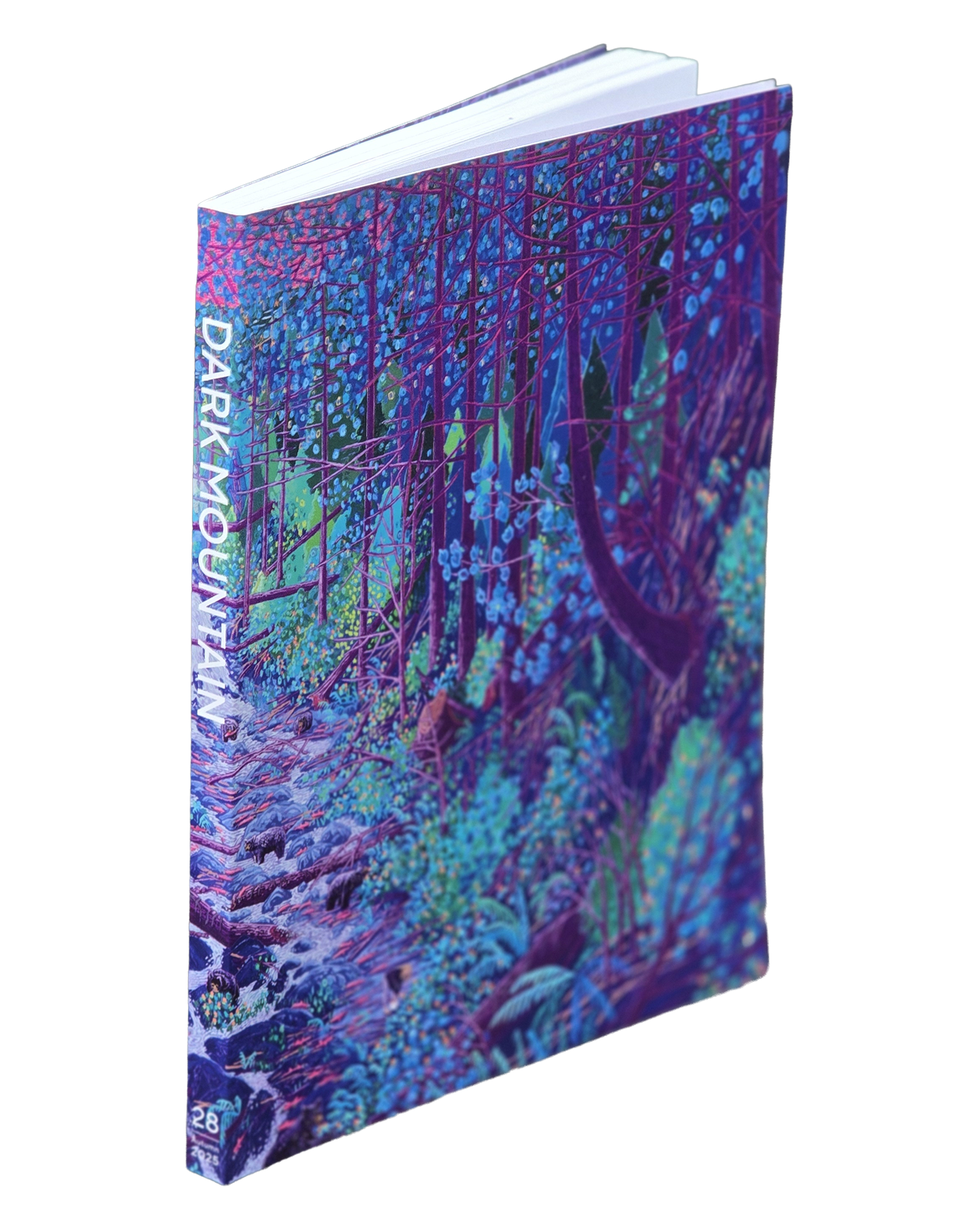
Dark Mountain: Issue 28 (£20.99)
Our Autumn 2025 special issue on Uncivilised Art celebrates the work and practice of artists in a collapsing yet still beautiful world. Order from our website or take out a subscription to future issues of Dark Mountain and get Issue 28 for only £13.99.
Our online edition
The Dark Mountain Project is an entirely reader-funded organisation. If you enjoy our newsletters or posts, please consider supporting our work by visiting our shop or becoming a subscriber to our bi-annual books or our weekly online edition on Substack. All back issues in the archive are available either in print (Issues 19, 21-23, 26-28) or as PDFs (from £5). Many thanks!
The Dark Mountain Project is wholly reader-supported. To receive new posts and support our work, please consider becoming paid subscriber. Many thanks!
From ‘Ozymandias’ by Percy Bysshe Shelley
 |
|
Gets at the deep angst that I and many feel about our ineffectiveness. But as I think the film concludes we must not give in and give up but keep on caring and acting for change.
Made me cry. I watched the film’s trailer and it was like a visit to Mordor.