

Birubi
From Dark Mountain: Issue 29

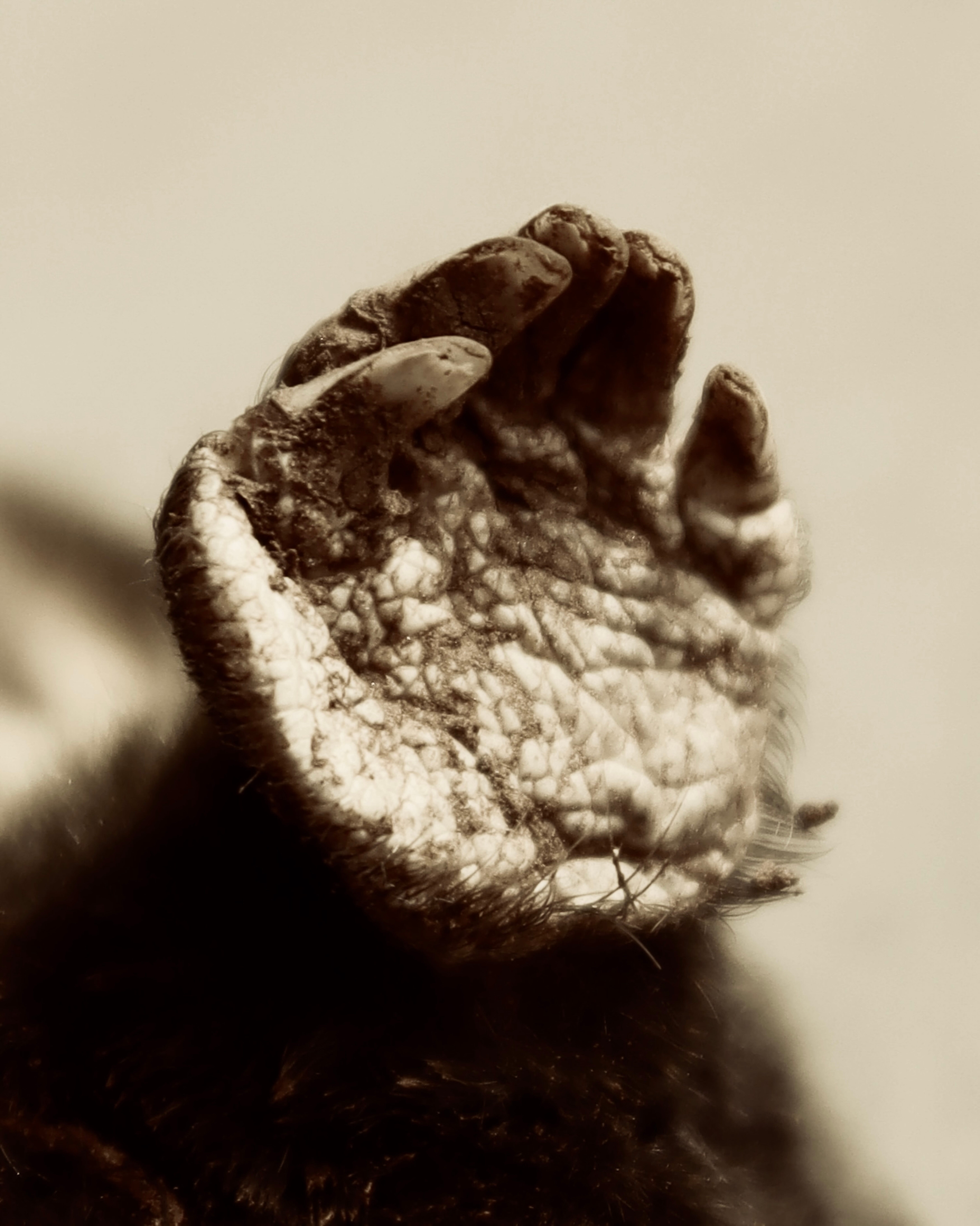
'Animals are the obvious diplomats of the more-than-human world, because they have faces, with which we can lock eyes, and be called into empathy.' Today, in the latest of our series of extracts from our new issue, we bring you Abi Andrews' essay on the intimate cohabitation between Australian ecophilospher Val Plumwood and Birubi, a rescued wombat. Accompanied by Ibby Lanfear's close-up portrait of a mole's foot.
And say the animal responded?
– Jacques Derrida
Why did Derrida not ask… if a Gregory Bateson or Jane Goodall or Marc Bekoff or Barbara Smuts… have met the gaze of living, diverse animals and in response undone and redone themselves and their sciences?’
– Donna Haraway
SMALL, TUCKED AND ROUNDED CREATURE, curled like a kidney bean, rough grey-brown fur, wide, silken nose. Koala of the undergrowth, similarly singular. Sick and malnourished, motherless, and mother-seeking, hurting at the loss of his own marsupial mother. Eager at the bottle and needy for affection. Responsive to contact, crooning, caress. In 1989, a year and a day after her son John died at 29 from a severe form of arthritis, a young wombat arrived at the mountain forest home of esteemed Australian ecophilosopher and activist Val Plumwood. Plumwood had taken him in under the supervision of a wildlife group local to her. This was in the Southern Tablelands, not far from Canberra. Birubi was around a year old when he and Plumwood met. She spoke of a strong attachment to Birubi, her second son.
Wildlife care is a peculiar meeting of human and wild animal, involving combinations of intimacy and estrangement. Wildness and domesticity are blurred in this context. For a time there is close contact between human and animal, and a high level of dependency. All being well, the animal’s strength returns, and contact lessens. Eventually, the animal sheds all association with the human world, returns to its wild home and behaves as though it never knew a human person. Embarking on wombat rehabilitation is a long-term commitment as wildlife care goes, because young wombat joeys need around a year and a half of human care to reach maturity and learn the skills they need to survive in the wild on their own. That’s a year and a half of a human carer making themselves available for regular feeds throughout the day (and in the younger stages throughout the night too), keeping a close eye on their charge, seeing to their specific, speciated needs, foraging native foliage for them – wombatifying your life.
In other ways, Plumwood Plumwoodified the life of Birubi, taking him into the nearby town of Braidwood for lunch with friends when he was a small joey still needing a bottle feed, or allowing him into the house when she had human guests. She described their relationship as cutting across the established boundary between the wild and the domestic, forest and house, nonhuman and human, nature and culture.
For the most part, Plumwood otherwise remained respectfully distant from the animals around her on the mountain she called home – she lived alone, in a remote forest five kilometres from a highway – taking joy in just observing them. The lyrebirds that performed their courting dances in view of the handbuilt stone house, the blue fairy wrens that flittered beside the windows, grabbing insects from the gaps in the stonework – for Plumwood, these were beautiful expressions of personhood, and she delighted in describing them to her human visitors. But Birubi was in need of her intervention – indeed, his life depended on it. And so ‘the wild’ came inside the philosopher’s home.
Nowadays, ‘humanising’ is seen as the great sin of the wildlife rehabilitation world; a carer whose charge becomes ‘humanised’ has failed in their duty to rehabilitate an animal such that it can independently survive in the wild. It is as though the human presence contaminates the animal, transforming it into a humanimal-mongrel, one which can no longer flourish in the othered world of ‘nature’ to which the animal truly belongs. Plumwood understood this as affirming a too-rigid binary between the human and the animal, between culture and nature – an iteration of what she called the ‘hyper-separation’ between humans and the natural world. Under the rubric of hyper-separation, domestication is top-down and unidirectional, rather than a potentially collaborative process. The hyper-separatist categories of ‘human’ and ‘nature’ do not allow for the possibility that the dance between human and animal can work both ways, and can be chosen by the animal themselves. For a hyper-separatist, only a human can exert influence on an animal, as in the case of humanisation.
Wildlife care is a peculiar meeting of human and wild animal, involving combinations of intimacy and estrangement. Wildness and domesticity are blurred...
But Birubi the wombat didn’t believe in distinctions such as these. Relentless ball of intent and fury, he could be driven to anger by being stopped from exerting his will, and sometimes, if thwarted, would hold a grudge until the next day, withholding his affection from Plumwood. He was also skilled at opening things, and would give exploratory bites to cupboards and furnishings, so that his desire and intention is marked on surfaces around the stone house to this day – his tooth marks are still on the door frames, for example, while a metal plate was fixed to the front door to stop Birubi’s gnawing. As Plumwood wrote, ‘He did not recognise human superiority or pretensions to own the world and had a strong sense of his own independent selfhood, his own equal interests and entitlements.’
Birubi had learned some wombat etiquette from his wombat mother before she died, and was trained from the get-go in defecating outside of the burrow. In this case, he must have understood Plumwood’s stone house as their shared burrow, because he learned to open the sliding glass doors in order to let himself out when he needed the toilet. But this also meant that he learned early the knack of letting himself back inside. He would arrive in the night, slide open the glass doors, and climb into bed with Plumwood. Plumwood insisted that Birubi initiated all these arrangements and that it was hard to turn him away from them.
At night, Plumwood would remove ticks and leeches from him – hitchhikers of the forest who crossed the threshold with him – and once beside her he would promptly curl up and go to sleep. She recalled that he often ground his teeth while he slept, making noises that suggested vivid dreams. Plumwood maintained that he played games and had a sense of humour. His incessant personality and his otherness were bewitching to her, and in contention with the science of animal consciousness at that time. Plumwood’s encounter with Birubi took place in the nineties, positioned between Nagel’s ‘What Is It Like To Be a Bat’, published in 1974, and the Cambridge Declaration on Consciousness – a landmark statement declaring that ‘humans are not unique in possessing the neurological substrates that generate consciousness’ – which would appear in 2012. Working through the problem of the animal and our relation to them, Plumwood was reading Midgley’s 1983 Animals and Why They Matter, an overview of the philosophical barriers the West has erected which disqualify animals from mattering ethically. From Descartes’ conception of animal machines to the claims of behaviourists that we cannot deduce feelings from observed behaviour, these views all hinged on the same claim: that animals lack sentience.
As Plumwood learned more about Birubi’s wills, desires, and sensibilities, she came up against this philosophical impasse. The claim that we can’t know the animal mind without sharing communicative language (something we manage to overcome in regard to other nonverbal humans – who unquestionably matter ethically) was repeatedly invoked. Meanwhile, charges of anthropomorphism, in which animals are presented as more humanlike than they actually are, were directed at those who found supposedly ‘human’ qualities in animals – attributions which were written off as irrational and unscientific.
Plumwood saw anthropomorphism as a weapon wielded to stop us from changing our thought, inhibiting any shift in our ways of seeing animals, or any return to an older, animate sensibility. Never mind the more common-sense notion that the demands of an animal’s environment would in all likelihood favour consciousness as an evolutionary advantage. Nor the fact that the burden of proof falls on the animal to demonstrate their consciousness, rather than on us to prove that they lack one. She believed that, as a counter to a world that goes out of its way to lessen animals, we should assume animal agency. We should start from the premise that the world is vibrantly alive, just as all our senses and intuitions tell us it is.
She lived this as an experiment in responding to Birubi, her collaborator, her co-maker of meaning, in all of his invitations. She described the two of them as ‘co-actors in a partially shared narrative of the world’. In her copy of Midgley’s Animals and Why They Matter, Plumwood had highlighted the line: ‘we are incurably members of one another.’ Theirs was an early experiment in co-becoming – she could have locked the doors to keep him outside once he was old enough to survive without her, and he may have eventually desisted from trying to chew his way in to her. But she didn’t do that. As the pair worked on rewilding Birubi, he chose to spend more and more time in his outdoor habitat, until he eventually built a burrow in her garden and set himself up, mostly, outside. Afterwards, they established the following pattern; he would visit the house most evenings, for ‘personal, moral, and material support’, a handful of carrots and oats, in exchange for his mowing of the lawn. He became an emissary, a shuttle between the world of the house and the world of the forest.
His ability to control the access between his world and mine enabled him to be active in choosing and structuring the balance between us, to enter my world while still fully retaining his Wombatness.
His choices delineated their relations as much as Plumwood’s did. The boundary crossing didn’t only happen from the human side, or via human agency. Plumwood had been reconfigured; she had become-wombat. Her close friend, the author Jackie French, described the uncanniness of this productive cross-contamination, the being-Birubi of Plumwood’s life and work. At Plumwood’s memorial in 2008 French would describe her as philosophically the most generous person in the world, with an extraordinary capacity for seeing, and carefully naming, the ways in which we imprisoned ourselves in ungenerous categorisations of life. At the same time, she could also be self-absorbed and determined, stroppy with others, fierce in her philosophical thinking, and given to working herself up into a fury in order to finish a paper. All of these characteristics, French said, were part of Plumwood’s ‘wombat-like gifts’.
Animals are the obvious diplomats of the more-than-human world, because they have faces, with which we can lock eyes, and be called into empathy. Mammals are especially relatable, as with them we share defining features; the strong mother bond, the mammary glands (punch cards to the Linnaean members club). Our continuity is recognisable, especially with the more social, charismatic ones. But the ramifications of recognisable animal intentionality ripples outwards, because once the forest becomes a domain of other minds with intentions and desires of their own, we step into a larger and more vital reality; no longer external masters of a world made only for our use and benefit, we become a small but exuberant part of something greater than ourselves. Recognition of animal intentionality is therefore part of an enlivening counter-project that spreads across the more-than-human world; a formerly ‘inert’ or ‘speechless’ forest becomes suddenly full of potential, other minds and the possibility of their response.
Plumwood would describe the agency and intentionality she saw in the forest all around her, where there were many other beings with desires, plans and intentions, who also cared for others around them. This included a wombat mother she came across while walking who, startled by Plumwood, curled herself around her joey to protect them, prompting Plumwood to reflect on parental love in other species. On her bookshelf was a well-worn copy of Kropotkin, who maintained that life in animal societies would be impossible without a corresponding development of social feelings such as attachment and compassion.
Choosing to be receptive to the narrative agency all around her, living deep in place, becoming the forest, Plumwood’s philosophical project was about becoming articulate in animism. For her, this animism also worked to resist the disenchantment which underpins the logic of hyper-separation, where our living world is reduced to a homogeneous plane of vacant automatons who matter less than us and our ‘civilised’ world. Instead, the natural world was alive and good and deeply lovely, integrally valuable. But Plumwood’s work was penned in on all sides by a hegemonic culture that was thoroughly alienated from the living world – and yet had a stronger foothold – foreclosing this communicative potential and therefore its ethics. The optimism of her earlier work dissipated after decades of campaigning to save forests from logging, as she realised that philosophy alone would not stem the tide of anthropocentric destruction. Her life on the mountain and its project of co-becoming was a small way to claw back from the grief of this painful knowledge, a grief she wrote of as looming large over her life. Her choice to receive nature as an active presence, and the forest community as a weft of interconnected and communicative others was a balm; an anchor down to home in a drifting, alienated world. The forest had come up from below and grown its tendrils around her. She wrote that all of her words had the thought of the forest behind them.
As she saw it, a part of the alienation was our blind-spot, an inability to see narrative and communication in nature because it did not look like what we see as communication. The animal science of the time had been fixated on teaching animals human language to gauge their communicative capacities, but had fallen apart in the eighties after public debates around misinterpretation of their data (in short, the anthropomorphism card was pulled). Although she doubtless took joy in the boundary transgressing and pedestal kicking of the animals that showed abilities in interspecies communication, for Plumwood the approach still smacked of human chauvinism. The experiments were not in the animals’ favour, and were not representative of their true capabilities (you try performing mental tasks under bright lights in an alien environment). Concerns around the effects of the lab environment on the expression of animal intelligence mirrored feminist arguments Plumwood had been working with around objectivity in science. But besides this, for Plumwood the language tests were not philosophically sound; they relied on hierarchical categories that still upheld human superiority, allowing only some, very clever and very special animals into the fold on the basis of their human-like qualities. In another piece of marginalia, Plumwood had written besides a line on teaching some animals to use our language, the provocation ‘suppose we learn their language?’ – a project she was certainly undertaking with Birubi.
This endeavour to teach animals human language revealed what she called our ‘assimilationist positions’, or our moral extensionism: the admittance of honorary animals into the fold does not allow for the ethical consideration of richer difference – does not account for uncommunicative animals, let alone trees, forests, rivers, wilderness, or species. What Birubi and the forest had taught Plumwood was that our ethics required an appraisal of both sameness and difference, which upheld our continuity with the more-than-human while still paying heed to ‘the other’s incommensurability’. The hyper-separation of nature and culture which posits humans and animals on two sides of an unbridgeable divide is catastrophic, but an obliterating sameness is also problematic. What we need is not a hegemonic over-identification with, or assimilation of, the other animals, but an active solidarity across difference. She would say of Birubi:
I was always conscious of a dimension of mystery in my knowledge of Birubi’s mind. The sense of bridging a great gulf of difference was part of the magic of the relationship. I think it was the centrality of the mother-child relationship to both our species and what was shared in its framework of ethics and expectations that made possible intimate contact with a creature so very different.
Drawing on postcolonial feminism, Plumwood develops the concept of ‘political solidarity’ in new ecological directions. Just as feminists argued that those with more privilege need to do more than just identify with women who are more marginalised than they are – and need in fact to take up a position of ‘traitorous identity’, resisting the norms that uphold their own privilege – likewise, we must become traitors to humankind, allowing the nonhuman to flourish for itself. We must accept and value the tenacious otherness of the world as a condition of our and their freedom. These were not just ideas for Plumwood. In 1985, she was attacked by a crocodile while canoeing in Kakadu National Park. After the attack, she strongly defended the right of the crocodile to express its natural predation behaviour, and asserted her own position as part of the food web. She campaigned to protect the crocodile that attacked her from being retributively shot.
After the attack, Plumwood strongly defended the right of the crocodile to express its natural predation behaviour, and asserted her own position as part of the food web
Humans, specifically those from the Global North, must move away from the supremacism that extends worth only to others that are like us. There are other intelligences at work in the forest, and although their communications are not usually directed towards us, or indeed even detectable for us, they nevertheless exist and are sometimes discernable if we learn to pay careful attention. In another piece of marginalia, she had highlighted emphatically that ‘different intelligences have arisen on different branches of the vine many times over.’
Plumwood often referenced Aboriginal thinkers in her work, on their ways of reading nonhuman communication in the land around them; their dialogical interaction with their world, in which ecological knowledge is built from observable patterns. In the Aboriginal worldview, communication is there for those who know how to read it, and is given over by ‘tellers’. Patterns such as March flies biting indicate that crocodiles are laying their eggs. The flies are communicating the change in season that heralds the crocodiles’ egg laying. This is valuable ecological knowledge, and because of it a person needn’t keep going to the billabong to check if the crocodile has laid; it is enough to be bitten by the March fly. In this communication system, there are always vital clues to tell you what is going on; action is both a message and a response.
In 1989 Birubi came to meet her. He called – in both senses of that phrase – and Plumwood responded. In 1999, after a decade of their experiment in cohabitation on the mountain, Birubi passed away.
He came to the house for sanctuary in his final months and often rested or slept in front of the fire, but returned to his burrow, snug pouch of mother earth, in his last hours.
A few days after his death, Plumwood held a wake for him on the mountain. During the ceremony, Plumwood and others who had known him told stories of Birubi and expressed gratitude for his life. In his eulogy, Plumwood addressed Birubi one last time, acknowledging his gift of divination:
You had the courage and freedom to cross the boundary, Birubi. But do we?
Abi Andrews is a writer, wildlife rehabilitator and landworker-in-training. She received a Culture & Animals Foundation grant for research on Val Plumwood and her Philosophical Animism, and is acting as caretaker at Plumwood Mountain in Australia while she undertakes the research. She is also working on a non-fiction book about wildlife rehabilitation as solidarity with the more-than-human.
IMAGE
Ibby Lanfear
Mole
Digital photograph
Old English stories suggest we have always been disturbed by the striking similarity of the mole’s forepaws to our own. Here in death (he was killed by a terrier) his hand reminds me of my father’s – a lifetime spent digging in the soil – and I see it as a warning about our own terrifying disconnection from the living, breathing world. After this image was taken I returned his body to the earth.
Ibby Lanfear is an artist, writer and colour maker based in the UK. Her work has been published by Wild Roof Journal, Dark Mountain and the Center for Humans and Nature. Her drawings are held in public and private collections. She can be found at ibbylanfear.com.
Our Latest Issue
Dark Mountain: Issue 29 (£19.99)
Our Spring 2026 anthology is a hardback collection that steps outside the human bubble and puts animals at its heart. Order from our website or take out a subscription to future issues of Dark Mountain and get Issue 29 for only £14.99.
The Dark Mountain Project is an entirely reader-funded organisation. If you enjoy these newsletters or posts, please consider supporting our work by visiting our shop or becoming a subscriber to our books and/or our online weekly edition on Substack. All back issues in the archive are available both in print (Issues 19, 21-23, 25-28) and PDFs (from £5). Many thanks!
This is a brilliant read! The opening with the kidney beans had me hooked immediately.
“Nowadays, ‘humanising’ is seen as the great sin of the wildlife rehabilitation world; a carer whose charge becomes ‘humanised’ has failed in their duty to rehabilitate an animal such that it can independently survive in the wild.”