

A Vaster Sanctuary
Review of 'Selah: A Báyò Akómoláfé reader'


‘Selah comes to us as a quiet summons - an invitation “to fall together, to read together”, to trace out new possibilities for what it might mean to care’. As an old world has cracked and splintered, the illuminating words of the ‘trans-public intellectual’ Báyò Akómoláfé have summoned those fugitive from its dominant mindset, and create a kind of sanctuary. Writer Mat Osmond celebrates his new collection of micro-essays ‘Selah’. With a short extract from the book, illustrated by Krista Dragomer.
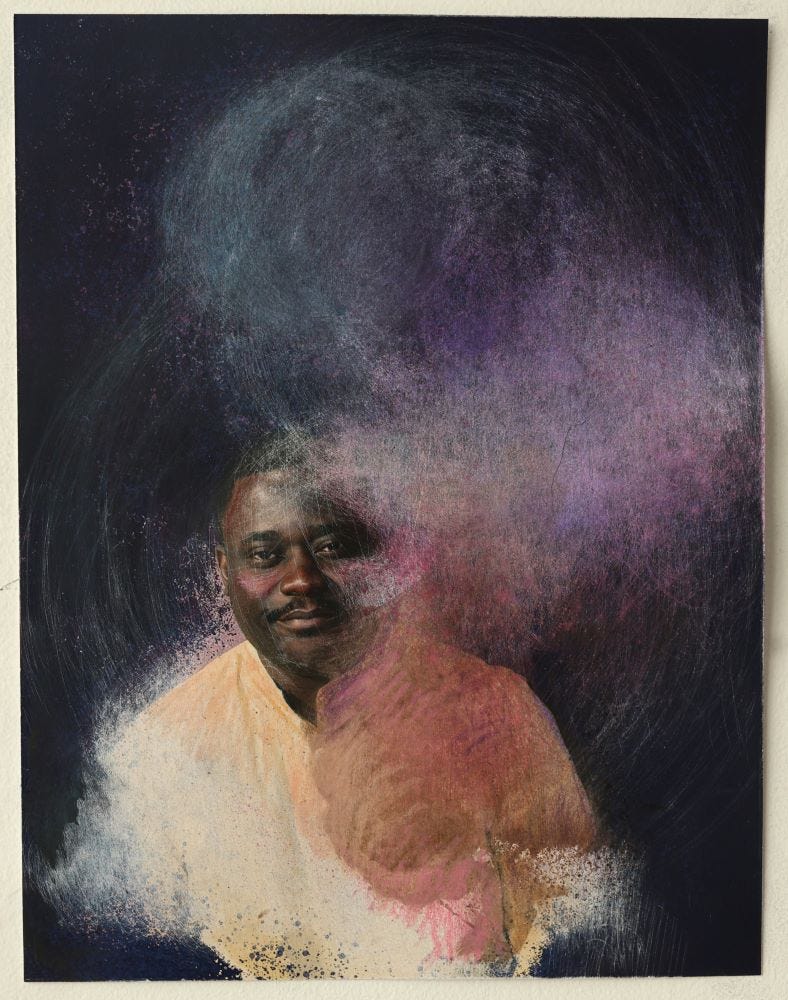
What might change if we were invited to sit still with the simple and yet troublingly profound idea that none of us has figured out how to live and none of us will? Might a stranger compassion take us then? Might it become easier for us to offer the project of our lives—the living of which no one seems to have gained expertise in—to the village of others with whom we’ve always shared our days?
(from Selah:A Báyò Akómoláfé reader
MY FIRST ENCOUNTER WITH BAYO AKOMALAFE happened in late 2019. As I recall it now he’s standing at the front of a spacious modern church, from where he delivers an unforgettable talk. The event’s title - a Yoruba proverb - will become synonymous for many of us with the paradoxical invitation his work extends: ‘The times are urgent, let us slow down’.
Unforgettable or not, I may have coloured some of this in. Perhaps it wasn’t a church at all? What I do remember - watching online - is being hooked by Akomalafe’s mock-sombre promise to his audience: that they won’t be leaving the building with any newfound spring in their ecological step. Instead of empowering them to speak to the heart-stopping implications of biospheric collapse, Akomalafe’s dubious-sounding offering is that by the end of the evening, if things go well, they may find themselves heading home with a newly-acquired lisp, or limp.
Bayo Akomalafe describes himself as a ‘trans-public intellectual’, a concept ‘imagined together with and inspired by the shamanic priesthood of the Yoruba trickster-healer’. His prolific contributions within the shared predicament of navigating empire’s collapse - whilst imagining what might yet be born in its ruins - includes the concept of ‘postactivism’. Akomalke’s deeply poetic approach to this notion teases open the dilemma so often bedevilling progressive spaces, wherever ‘the puritan ethical response of contemporary activism and conscientiousness cannot meet the overwhelming demands (or rise to the occasion) of transformation’.
Another key idea at play in Akomalafe’s work is that of ‘the Afrocene’, where we come to understand that, living within the social and thought structures of colonial modernity, ‘we are still on the slave ships’ - whether our lives are situated above deck, or below. As he puts it to Charlotte Du Cann in an interview for Dark Mountain: Issue 19, ‘Our elders are asking us to look at the slave ship, not as a thing that is gone and done with but as a thing that is energetically present, right now’.
Known to many through his radical innovations within online education and community spaces, perhaps most notably the celebrated We Will Dance With Mountains series, in recent months Akomalafe has taken things a step further with Laura Peña Zanatta at The School of Cracks, a trans-public experiment that wrestles the ‘singular question’ now showing up with ever-greater insistence: ‘what do we do? How do we become responsible to these moments of ruin and rule? How do we show up at the end of the world?’
Last December, finally attending one of his courses myself, I heard Akomalafe mention a new book he was currently working on, which he spoke of as ‘a collaboration with a theologian about the notion of awkward grace’. Once again, my attention was hooked.
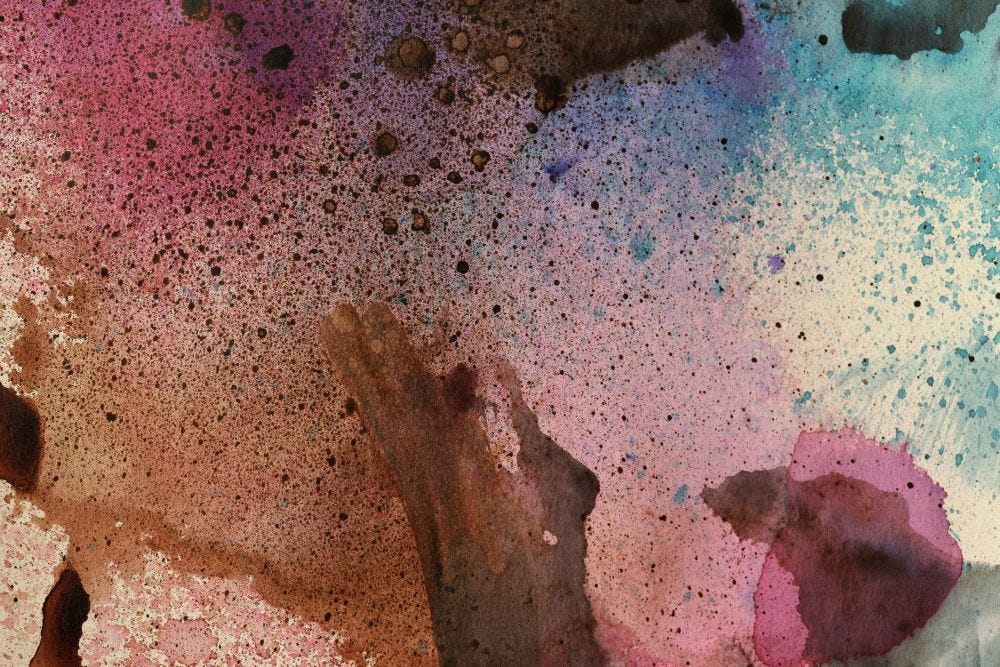
Among many things Selah is a labour of love. Its collaborative weaving of Akomalafe’s short prose-poem reflections and exclamations has emerged from a conversation with the artist and scholar of Hebrew philology and biblical poetics, Eden Pearlstein. The flow of these brief micro-essays has then been complemented and slowed by a second artist, Krista Dragomer, whose visual work punctuates the book with a series of dark, burnished silences.
As Selah’s short passages move lightly between colonial history, arboreal biology, Yoruba gods and folk tales, the quiet epiphanies prompted by Akomalafe’s son Tayo – ‘my autistic six-year-old prophet of the crossroad’ – and a great deal else, decolonisation comes to meet us, in one guise after another, as a persistent:
queering of things, of relationships, of assumptions. A stunning ‘what if?’ that pulses in the veins of our necropolis … an ethical call flowing with the currents of things, inviting us to listen to the murmurs of the supposedly “dead” and “instrumental” world around us.
*
In one of these meditations Akomalafe tells us about the Sunday morning when, as a young church-going Christian in Nigeria, it suddenly struck him that God was no longer in the building. As I read and re-read Selah - this isn’t a book to be read once and set aside - I kept coming back to this recollection, as if it marked a spot from which Selah’s threading thought adventures radiate outwards and burrow inwards: that ordinary Sunday morning when a younger Akomalafe became aware that God had quietly ‘slipped away, leapt over the fence, shed his embroidered robes’ and run ‘mad and naked into the wilderness’.
Recalling how those around him ‘went on as usual, stomping up dust storms, screaming loudly, adoring him with all his usual names’, Akomalafe tells us how from this moment on, those ever-receding footsteps:
glowed seductively in the rough sands where he had declared his freedom.
His clothes marked the spot where he slipped away, no longer hesitant about what he had done. His great sin: re-enchanting the ordinary. His sacrilegious act: changing his name and address to—everywhere.
*
Selah takes its title from an enigmatic Hebrew word that appears throughout the Book of Psalms. Eden Pearlstein tells us that biblical scholars have yet to settle on this word’s meaning, with their interpretations ranging from a moment of ecstatic exclamation, to a shift in the thematic flow of the psalms, to a choral notation that indicates a pause or break of some kind - ‘a breath’.
No part of that rich ambiguity is wasted here. In its unresolvable resonances selah rhymes well with the awkward-exultant grace which permeates both the form and the feel of this book, and Akomalafe’s work more generally - by turns beguiling, challenging and disarming the reader. In Akomalafe’s hands selah comes to us as a quiet summons - an invitation ‘to fall together, to read together’, to trace out new possibilities for what it might mean to care.
Selah opens with Akomalafe’s avowed distrust of doorways, and with his preference for what he likes to speak of as cracks: unplanned ruptures whose awkward presences trouble the architecture of our personal and shared lives, complicating and spoiling the endlessly-smoothed surfaces of our modern ‘wellness’. The trouble with doors, we learn, is that:
like the solutions we often offer to our most persistent civilizational challenges, doors allow us to shuffle within the already-known, to move the pieces around in the name of innovation, while maintaining the design. Doors ‘behave’.
Cracks, by contrast, being born of frictional forces and agencies quite other than willed human intention, do not and will not behave: ‘Architects don’t design cracks, don’t anticipate cracks. Cracks are not part of the furniture; they are the excessiveness of the frame. Design’s ecstasy.’
*
The British-American writer and Zen teacher Alan Watts once noted a curious impression about the religion in which he’d been raised:
For as long as I can remember, I have been puzzled by the fact that I can only feel like a Christian when I am indoors. As soon as I get into the open air, I feel entirely out of relationship with everything that goes on in a church … in a closed sanctuary where the light of the open sky comes only through the symbolic jewellery of stained glass windows.’ (Nature, Man and Woman)
Watts’ observation kept coming to mind as I read Selah. I find myself taking Akomalafe quite literally when he speaks of fleeing the built sanctuaries of anthropocentric religion - Selah does indeed invite its reader ‘out’ into an animate cosmos teeming with intelligences and sensibilities other and far older than our own. But its re-enchantment of the ordinary goes much further than taking worship outdoors. The absconded more-than-human God whose footsteps Selah traces, having changed his address to everywhere, now wells up through the cracks spidering our everyday lives – at their crowded urban centres no less than their dwindling wild margins.
Just as cracks are ‘neither internal nor external’ to the architectures they fissure, in the version of ordinary that Selah meanders, once-obvious distinctions like inner and outer become ever more redundant: ‘The hallowed interior is broken; the mute exterior breached. The soul is at large, off the record, beside itself, always-to-come. And all we are left with is a gasp.’
Sometimes, Akomalafe tells us, he still gets asked why he no longer shows up at church on Sundays. When this happens, he says:
I often try to tell them about this confounding notion of “god” – about this bubbling spring that wells up in the cracks of the ordinary, urging us to notice the world anew. I want to tell them about a vaster sanctuary I am coming to know: not one where you walk in broken and leave mended, but one where you walk in mended and leave broken. Where you walk in eloquent and leave with a lisp. Where the cavorting gait of the confident is disciplined by the hand of god upon the thigh—dislodging the bones.
*
When I encountered Bayo Akomalafe standing at the front of that might-have-been-a-church, the world seemed a very different place to today’s. Six years on, the slowing ‘politics of tenderness’ Selah advocates, wherein cracks appear as first responders in a world fast becoming ‘too solid for nuance’, evokes a simpler and more unequivocal yes - more like a sob than a considered murmur of assent.
Does resisting this solidifying darkness require us to have a plan? As we feel our bones begin to loosen, perhaps bewilderment would serve us better. Unless we cultivate bewilderment, Selah proposes, ‘we will risk seeing things too clearly in a world and at a time when clarity often gets in the way’. Without suggesting that we shy away from active engagement – whatever that means to us - Selah urges us to root the forever unfinished project of our lives in ‘a stranger compassion’, one which understands ‘that none of us has figured out how to live and none of us will’.
Whatever the cracks we find ourselves enlisted by in the coming days and decades, now is a good time, Selah whispers, to become better acquainted with loss, and with loss’ hidden life: to understand loss as a thing ‘infected with becoming’, beckoning us out of our insular modern lives into a vaster sanctuary. The paradoxical reassurance Selah leaves us with is that it’s precisely in our stupefied brokenness, in our inability to either solve or escape what we are, that our lives become porous to ‘the nurturance of grace that allows something different, something even beautiful, to be born in the midst of the fires that surround and engulf us’.
Selah
a short extract


WE HARDLY NOTICE IT IN THIS WAY but loss is the most delicate creation of the universe. Its most exquisite art. A carrier bag of new fictions might pick loss up, moist and soft from the earth, and give it a pride of place among the war-exhausted narratives about how new things come to be. Loss needs a new cosmology—a minor gesture that touches the sapling in the soot of demise. Loss needs a new cosmology: not one that treats it as a deficit, something to fill quickly with a replacement; nor as sustainability—the disguised primal cry of the modern self in search of permanence. Loss needs a new home. Suitably, one that wanders.
Regeneration does its best work, I would suppose, not as a sign of clumsy replacements of lost things, a sprouting into empty space of an iteration of what was previously taken—as would be the case if we imagined the world to be composed of stable things that occasionally go missing. Within such an ontology, a world of infinite growth and progressive capture, absence is problematic—a void to be filled. Like Death to the author of Revelation: a final enemy to be vanquished. In this world, regeneration fits into an economy of named things, of saved things, accommodated within our systems, proper only to the extent that it serves “us.”
But doesn’t loss have a hidden life? A secret fermenting in its body like a fungal parasitoid in the chest of an insect? At what point does grieving become the choreography of a strange joy? Maybe loss is also infected. Infected with becoming. Maybe we need to think of loss in more fruitful ways. Maybe loss needs a new ontology. Maybe regeneration does its best work … as a call to worship.
*
There are stowaway worlds tucked into the dense folds of the ordinary. Hidden lives, secret celebrations. Appliances conversing with each other when we’ve gone to sleep. Dolphins arguing about which experimental modality is more appropriate for studying the human that researches them. Spider cognitions braided into the arachnean corners of a decrepit apartment. Slave bones humming freedom beneath the asphalt of a post-racial utopia. Gut bacterial families whispering their desire to our brains. A zombie—the forbidden child of the crossroads, born at the site where empire meets magic—lurks at the peripheries of the modern. We can never be sure of what the world is doing next, what it is producing, what lines are being blurred, what categories are being composted. If we do not cultivate bewilderment, we will risk seeing things too clearly in a world and at a time when clarity often gets in the way.
*
A dry, browning, withering leaf still attached to the stem sustains marcescent relations with its tree. “Marcescence” names arboreal practices in which fading leaves no longer draw nourishment from their trees, and yet are kept in place, mesmerized in their wilting, unable to fall away as winter howls its piper’s tune.
Something about marcescence hints at dominant practices, especially in justice-oriented movements, of seeking greater freedoms, greater expressibility, greater access, or greater representations within relations that no longer nourish. Within epistemologies that incarcerate futures. When this happens, when our labors are concerned exclusively with seeking more “freedom,” we risk fortifying marcescent dynamics. We risk reproducing patterns that exceed the immediacy of resolutions.
Transformative differences may not always be tied to seeking greater freedoms or greater stability within familiar worlds. Quite to the contrary, it would seem that it is in the falling away, the descending, and the waltzing to the earth, that potential new worlds unfurl.
Cracks portend some kind of crossroads captivity: one has to be carried away, shapeshifted, crossed out, and “taken.” From the perspective of marcescent freedom, this falling away might look like pathology, like something to be fixed, like an unfortunate deviation from proper society. But there’s perhaps nothing more promising to the otherwise, to the prospects of new subjectivities than a leaf that has fallen off its branch. The monstrosity of a fallen leaf, torn away from its tree, is a prophecy of forests yet to come.
Báyò Akómoláfé, PhD is a celebrated international speaker, posthumanist thinker, poet, teacher, self-styled ‘trans-public intellectual’, and essayist. He is the author of two books: These Wilds Beyond Our Fences: Letters to My Daughter on Humanity’s Search for Home and We Will Tell Our Own Story: The Lions of Africa Speak (with Professors Molefi Kete Asante and Augustine Nwoye). Akómoláfé is the founder of the Emergence Network, a planet-wide networking project and inquiry at the edges of the Anthropocene. He lives between Chennai, India and Great Barrington, Massachusetts with his family. He considers Brazil to be his spiritual home.
Mat Osmond is a writer and educator based in Cornwall. His recent essays have gravitated to the space between active resistance and related spiritual repair. Since October 2023 the ongoing Palestinian Genocide has overturned his understanding of both these terms. Mat’s currently co-editing a new book with the Devon-based Art.Earth collective: The Breath We Share; embodied creative practices for a living and dying world
Selah: A Báyò Akómoláfé Reader was published last month by Aora Books
Our Latest Issue
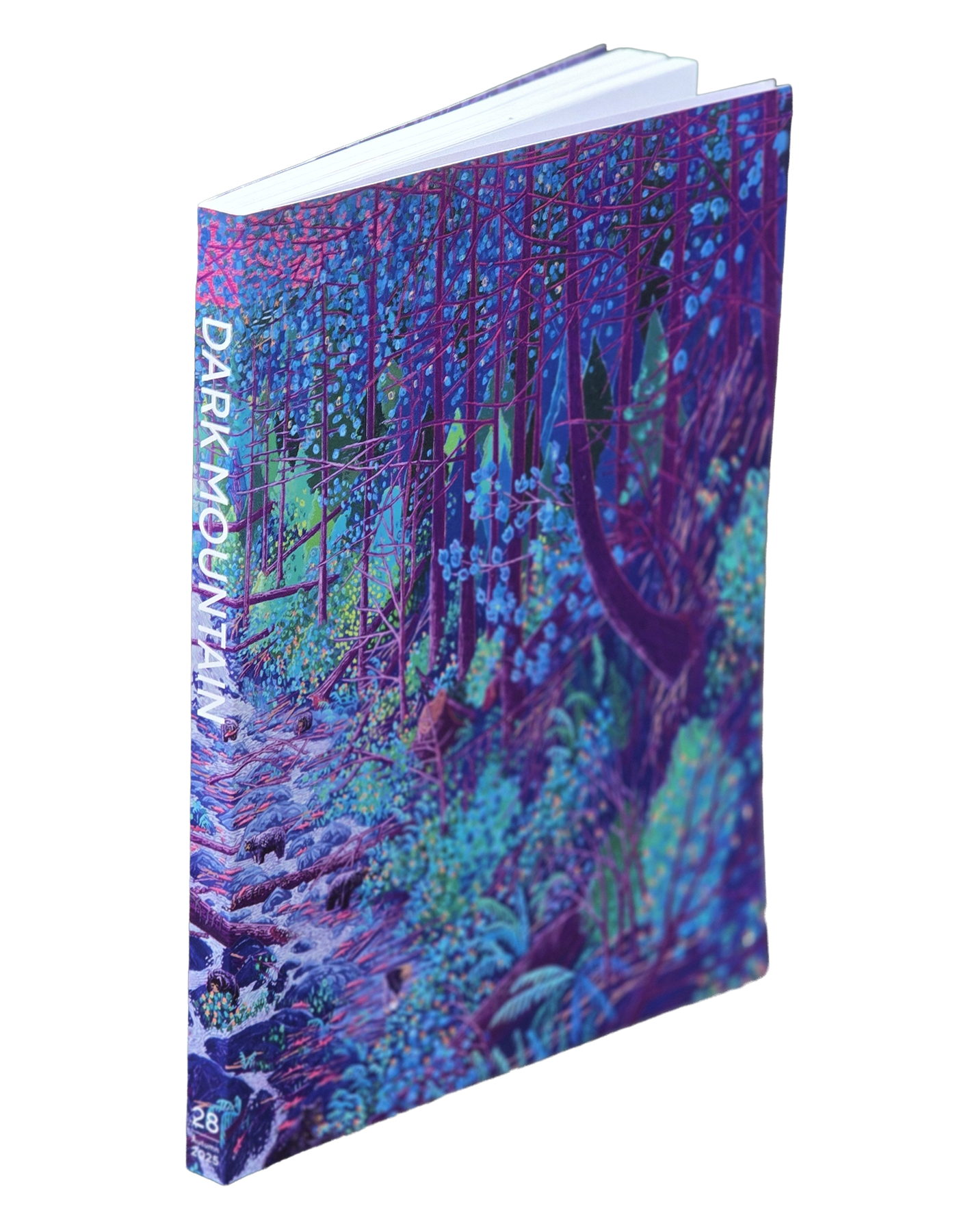
Dark Mountain: Issue 28 (£20.99)
Our Autumn 2025 special issue on Uncivilised Art celebrates the work and practice of artists in a collapsing yet still beautiful world. Order from our website or take out a subscription to future issues of Dark Mountain and get Issue 28 for only £13.99.
The Dark Mountain Project is an entirely reader-funded organisation. If you enjoy these newsletters or posts, please consider supporting our work by visiting our shop or becoming a subscriber to our books and/or our online weekly edition on Substack. All back issues in the archive are available both in print (Issues 21, 22, 25-28) and PDFs (from £5). Many thanks!
 | A guest post by
|